


Your request is accepted,
we will contact you soon
 Author of the article
Irina, expert of the project
Published: 14.10.2026
Views: 4 974
Views: 4 974
The famous Arseny Morozov mansion is not the only architectural landmark on Vozdvizhenka Street. Nearby stands the lesser-known yet noteworthy Varvara Morozova estate, dating back to the late 19th century. Its walls once hosted literary salons where the voices of Chekhov, Tolstoy, and Blok could be heard, while high society life thrived in its grand reception halls. In this article, we explore the history and architectural features of the estate at 14 Vozdvizhenka Street.
History of the estate
The mansion at 14 Vozdvizhenka Street was built between 1886 and 1888 and became one of the first major works of architect Roman Klein, who would later go on to design dozens of iconic buildings in Moscow. The client was Varvara Alexeyevna Morozova—a philanthropist and entrepreneur, and an heiress to the renowned merchant dynasties of the Khludovs and the Morozovs. In 1885, following her husband’s death, she purchased the former property of the Dolgorukov princes and decided to build a new residence on the site.
The house quickly became more than a private home—it emerged as a center of Moscow’s cultural life. Dozens of guests gathered in its spacious grand hall, where literary and artistic salons were held and figures such as Anton Chekhov, Leo Tolstoy, and Alexander Blok were among the visitors.
The main building on Vozdvizhenka was completed in 1888. A few years later, in 1891, its composition was expanded with two annexes designed by architect Viktor Mazyrin, who would soon afterward build the famous mansion for Morozova’s son, Arseny.
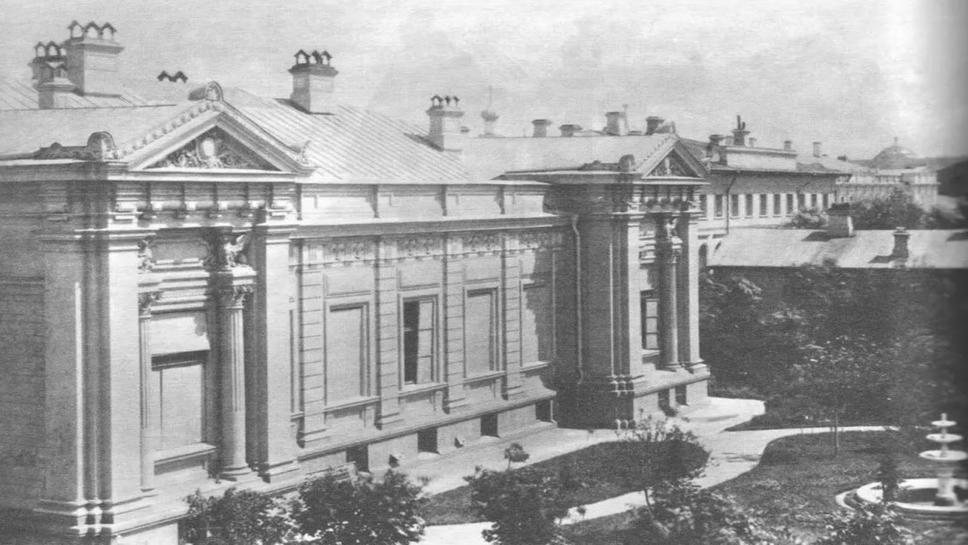
The Varvara Morozova Estate at 14 Vozdvizhenka in the 1900s. Source: pastvu.com
The Mansion in the Soviet Time
Varvara Alexeyevna Morozova passed away in 1917, on the eve of the October Revolution. Soon afterward, her house was nationalized and transferred to military authorities. As early as 1919, it became home to the State Museum of Social Hygiene of the People’s Commissariat of Health of the RSFSR, and from 1923 it housed the Institute of Social Hygiene headed by Alfred Molkov, which operated until 1930. During the same period, part of the building was occupied by the International Agrarian Institute affiliated with the Krestintern. The service wing was adapted for use as a dormitory and a printing house for the Moscow Agrarian Institute and was rebuilt in 1930 by engineer Dedov.
In the Soviet era, the mansion’s appearance changed significantly: a third floor was added, the grand entrance porch was removed, and the façades lost much of their original expressiveness. Nevertheless, many of the richly decorated interiors survived, albeit bearing the marks of careless renovations.
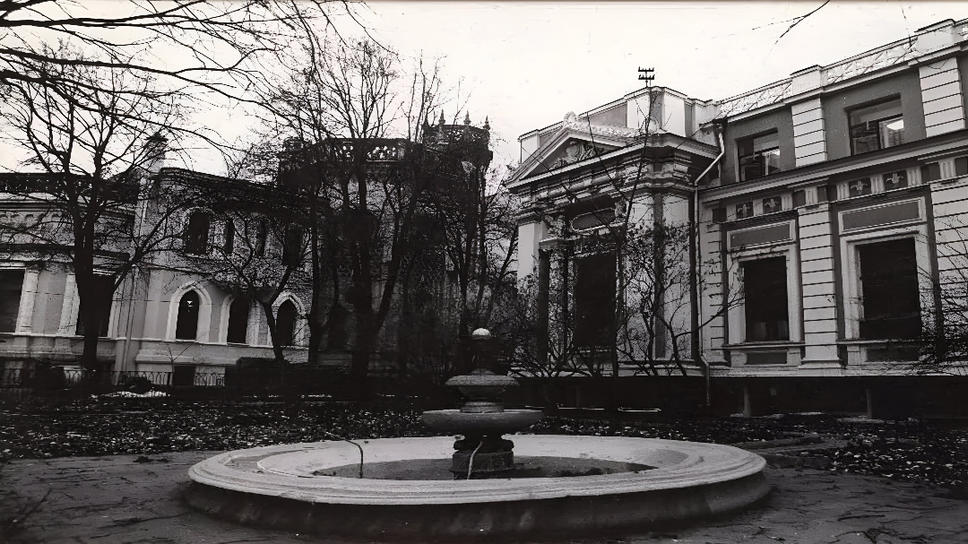
The Morozova Estate on Vozdvizhenka in the 1980s. Source: pastvu.com
Architectural Features
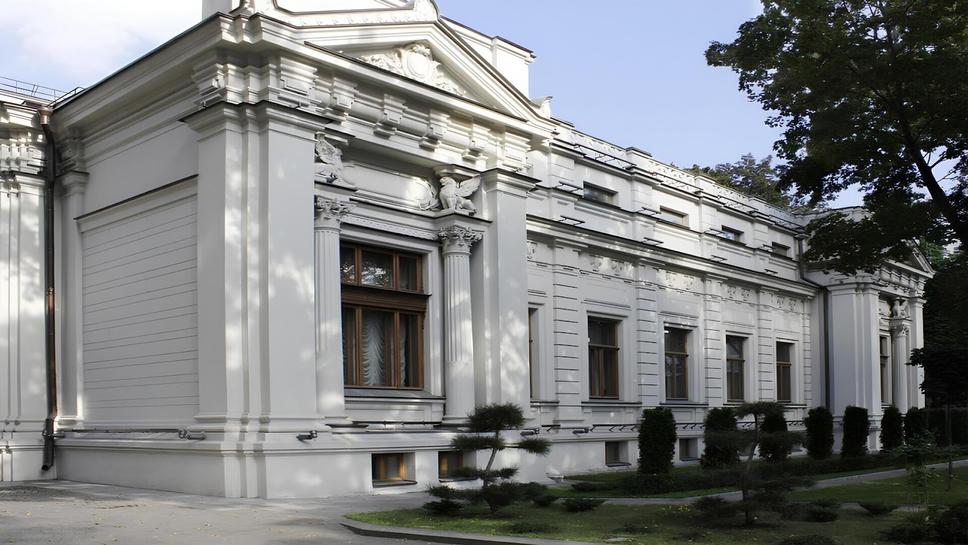
The mansion was designed in the Neoclassical style. Its main facade faces Vozdvizhenka Street, while the building itself is set back from the busy roadway by a small landscaped square. The architectural composition is defined by two projecting side risalits with porticos adorned with pediments, columns, and sculptural griffins.
Architect Roman Klein described the mansion at 14 Vozdvizhenka as “an Italianate urban palazzo — a Moscow reminiscence of an Italian prototype, both in its frontal and spatial composition, in its rhythm, and in its relationship to the specific character of the Russian urban estate.” His contemporaries noted that the interiors were conceived in an English spirit: restrained, practical, and free from the excessive opulence typical of many Moscow mansions of the 19th century.
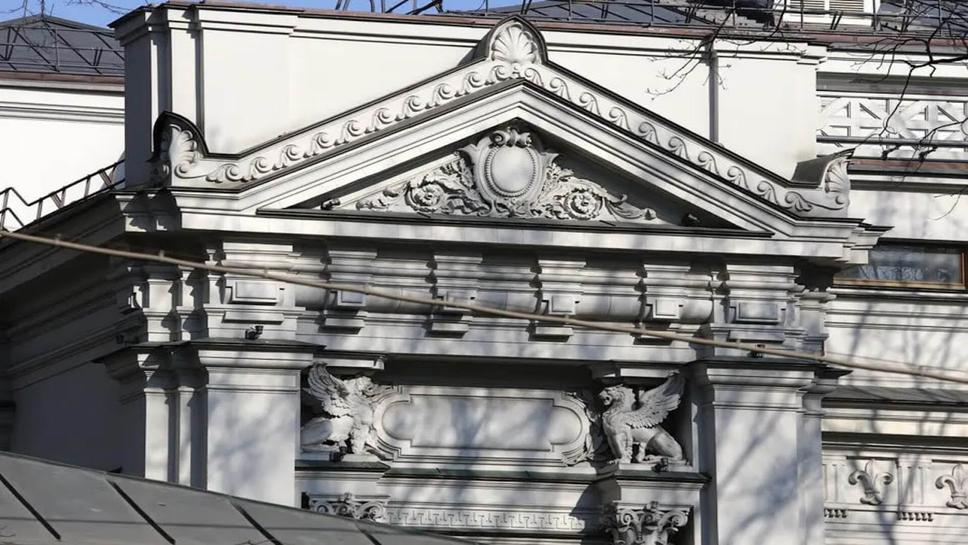
The facades of the estate are adorned with pediments, bas-reliefs, griffins, and columns. Source: um.mos.ru
Restoration of the Estate
From 2007 to 2013, the mansion at 14 Vozdvizhenka Street underwent a large-scale restoration that returned it to its historic appearance. The work was carried out with exceptional attention to detail: conservation architects conducted chemical and technological analyses of the paint layers and restored the original facade color — a light gray tone that was initially intended to resemble natural stone.
Inside the building, the enfilade — a long, continuous sequence of ceremonial rooms—was reopened. Ceramic and parquet floors, plaster finishes, and stucco decoration were brought back to life, and the fireplaces were restored. The monumental wall paintings were treated by professional conservators, who sought to achieve the closest possible match to the late 19th-century originals.
In the library, 32 delicate grisaille rosettes set within stucco coffers on the vaulted ceiling were restored. The wall bas-reliefs were carefully cleaned of multiple layers of paint and finished with a patina evoking aged bronze. In the boudoir, sections of the molded stucco profiles were replaced, and the walls were cleared of old paint layers.
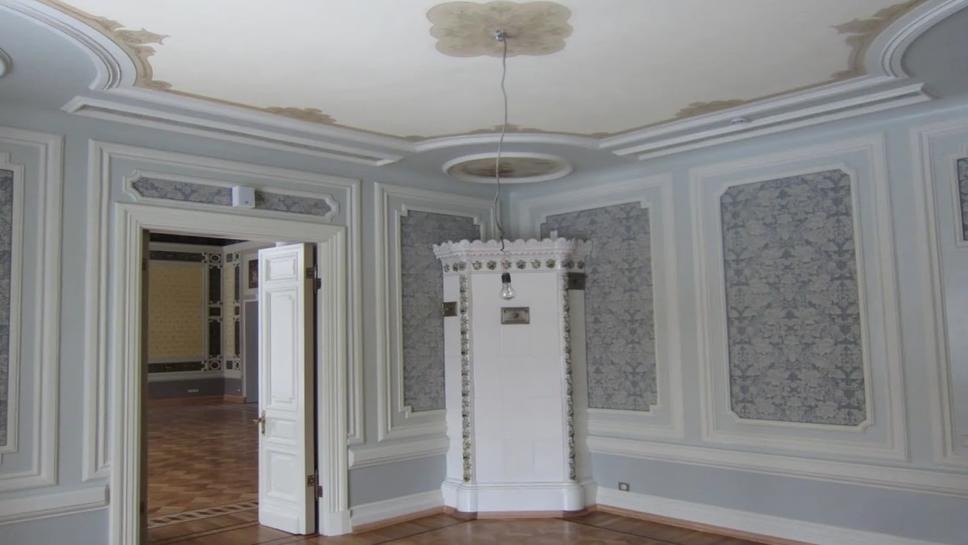
One of the halls of the Morozova mansion after restoration. Source: um.mos.ru
In all the ceremonial halls, the unique Pompeian-style ceiling panels were restored. The color schemes of the stucco decoration and wall paintings were brought as close as possible to their original appearance. Lighting fixtures, furniture, and draperies were selected in keeping with the stylistic character of each interior, allowing the ensemble to regain its sense of harmony and unity. Outside, on Vozdvizhenka Street, the appearance of the garden fountain and the historic fence with its gates was also restored.
Following the restoration, the mansion regained its former grandeur. Today, its state rooms are used to host official receptions for foreign delegations, and the building is administered by the Presidential Property Management Directorate of the Russian Federation. Since 1997, the Morozova mansion on Vozdvizhenka has been protected by the state as a listed architectural monument. In 2013, the restoration project was nominated for the Moscow Government’s Moscow Restoration competition as a contender for one of the finest examples of architectural heritage preservation.
Conclusion
Having survived the passage of time and undergone meticulous restoration, the Morozova mansion at 14 Vozdvizhenka Street has regained its historic appearance. If you are interested in purchasing a mansion in Moscow, request a callback on the website—your personal manager will provide information about available options.