


Your request is accepted,
we will contact you soon
 Author of the article
Irina, expert of the project
Published: 11.04.2023
Views: 6 291
Views: 6 291
The von Derviz mansion is a majestic building that organically combines elements of various styles, from classical to modern. This house is a fine example of late 19th-century architecture, as well as a historical monument that has retained its original appearance, beauty, and elegance for over 100 years.
Definition and general description of the von Derviz mansion
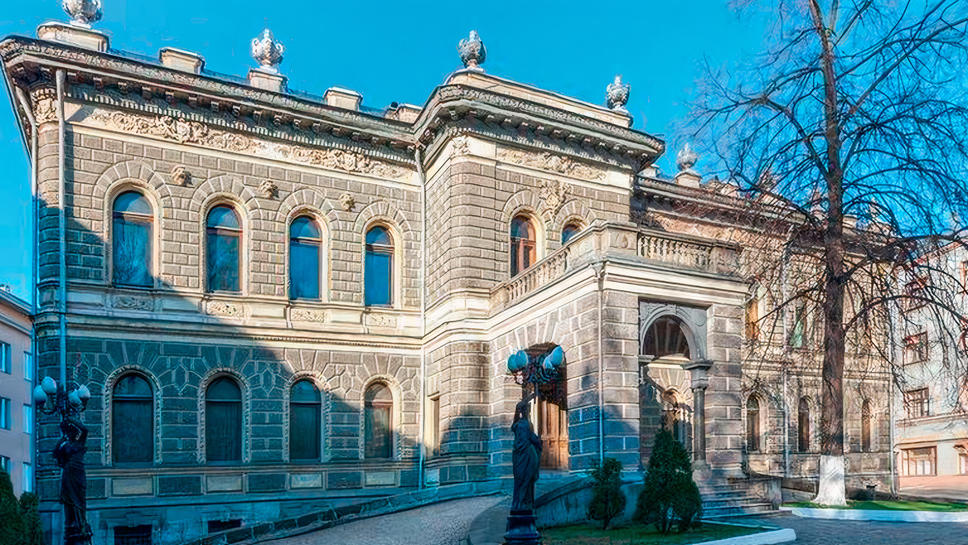
The idea to build a mansion on Sadovo-Chernogryazskaya Street in the quarter bordered by Krasnye Vorota Square and Bolshaya Kozlovsky Lane belonged to Sergei Pavlovich von Derviz, a state councilor, entrepreneur, and patron of the arts. He was the son of the famous Pavel Grigorievich von Derviz, who managed to amass a staggering fortune from the construction of railways in Russia. The house was built between 1886 and 1888. The front facade can be seen from Sadovo-Chernogryazskaya Street, while the rear facade can be admired from Khoromny Lane.
The building, reminiscent of a Florentine palazzo, is located at the back of the plot and hidden from prying eyes by a massive stone fence. Large plaster rustication with a fur coat finish covers all of its exterior walls, making the mansion look like an impregnable fortress. The mixture of different styles gave the house an extraordinary appearance.
Brief biographical information about the architect
The construction of Baron von Derviz's mansion was carried out by Ryazan architect Nikolai Mikhailovich Vishnevetsky and his young and promising colleague Fyodor Shekhtel.
Nikolai Mikhailovich Vishnevetsky graduated from the Construction School with the title of civil engineer.
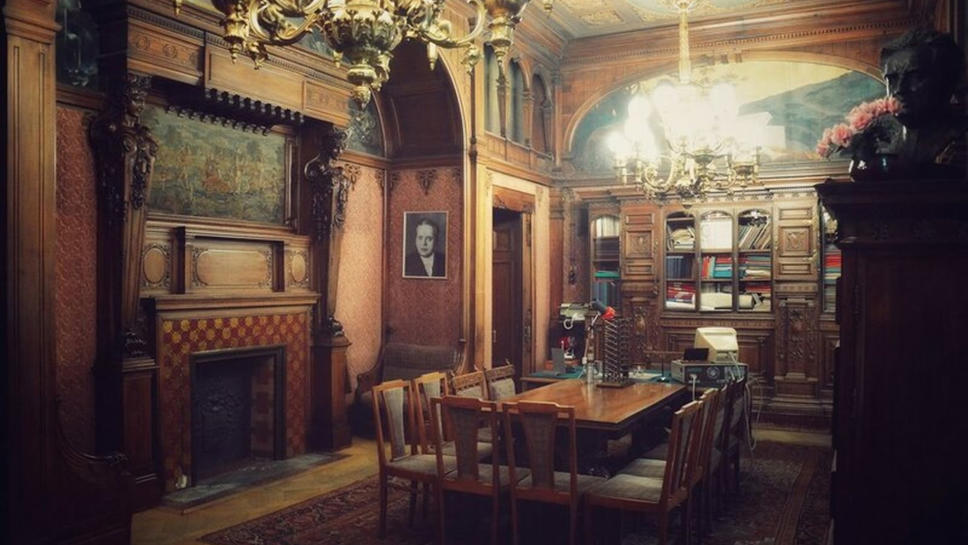
The main achievement of the famous Russian architect Fyodor Shekhtel was the creation of a style known as Russian Art Nouveau. He boldly experimented, mixing diverse architectural styles, resulting in extraordinary and impressive solutions. Preserved interiors of the house.
Briefly about the von Derviz family
Sergei Pavlovich's ancestors came from the German von der Wiese family. The founder of this dynasty was Johann Adolf Wiese, a native of Hamburg who was educated at three of Germany's most advanced universities. After moving to Russia in the 1740s, he was appointed justice advisor to Peter III's Holstein service and in 1759 was honored with a title of nobility in the Roman Empire. As a result, the prefix “von der” was added to his surname. Later, the family name was transformed into “von Derviz.”
The sonorous prefix did not bring its bearers any special privileges or wealth. However, one of them managed to become fabulously rich as chairman of the Moscow-Ryazan Railway Society, which led to him being called the “Russian Count of Monte Cristo.”
We are talking about Pavel Grigorievich von Derviz, who managed to attract private investors to the construction of railways. Together with his permanent contractor Karl Fedorovich von Meck, they worked on the construction of the Moscow-Ryazan, Ryazan-Kozlovskaya, and Kursk-Kiev railways. At the same time, Pavel Grigorievich was involved in charitable activities, creating and supporting educational institutions, hospitals, and cultural institutions. For example, the construction of the St. Vladimir Children's Hospital in Sokolniki was carried out with funds donated by him. His wife and sons continued his noble work. After his death, they became owners of real estate in Moscow, St. Petersburg, Ryazan, Switzerland, France, lands in the Orenburg and Kiev provinces, and steamboats that sailed on the Volga. The funeral service for his father and sister Varenka, whose death caused Pavel Grigorievich a stroke, was held at the Church of the Three Saints near the Red Gate. Not far from this church, the son of the deceased, Sergei Pavlovich von Derviz, would later build his mansion.
The heir to the “Russian Monte Cristo” was less successful in business than his father. He managed the family business as best he could, served in the Ministry of Justice, but his real passion was art – playing the piano, composing music and poetry, and his love of the theater.
The revolutionary events of 1905 prompted Baron von Derviz to sell his mansion and other properties in Russia and move to France in 1908.
Description of the interior and architecture of the mansion
Eclecticism was the defining style in the construction of the mansion, but the combination of selected styles and architectural elements was unusual for Moscow.
The main accent of the facade is the unusual front entrance. It is a strongly protruding risalit with front and side arches. An impressive stone porch adjoins the front edge of the building, with semicircular ramps on the sides, decorated with statues of women, which also serve as lamps. The risalit is covered by a roof, which also serves as the base for the balcony on the second floor.
The coat of arms of the von Derviz family is displayed on a cartouche in the center of the risalit. The spaces between the windows are decorated with lion masks. The inter-floor belt is decorated with intricate stucco molding, the frieze with fairy-tale dragons, and the window openings with garlands of leaves and fruits. The attic is topped with pedestals connected by light grilles and cornices with flower pots.
In addition to the owners' private rooms, the building also houses living rooms, ceremonial halls, a reception room, a dining room, a billiard room, and an oriental room. In addition, there was room for a winter garden, a fireplace room, the owner's study, and even a safe room. The basement was reserved for utility and service rooms. The building was equipped with water and sewage systems.
The interior design was based on Shekhtel's original sketches.
A Gothic style was chosen for the lobby, while Chinese motifs were used for the eastern room. Some rooms were designed in a style that could be described as early modern. The house is striking for its abundance of gilded and molded elements, stained glass windows, rich paintings on the ceilings and walls, fabric wall coverings, tapestries, and wallpaper. Many rooms are decorated with fireplaces.
Personal account interior
How was the mansion built?
Vishnevetsky completed his part of the work in 1886. After that, Sergei Pavlovich brought in Fyodor Osipovich Shekhtel, who had previously created a unique architectural estate for him in the Ryazan province. Impressed by his creation, von Derviz decided to entrust him with the work on his mansion in Moscow.
The lack of a full professional education prevented Shekhtel from independently supervising construction work in Moscow until 1894. Therefore, he built von Derviz's house under the guidance of Zalesky, an outstanding engineer and architect.
Initially, the building was symmetrical and had four windows on each side of the risalit. As a result of the changes made by Shekhtel, the house was extended with three windows and a rounded end. This made it possible to organize more reception rooms and create a cozy space for the owners of the house.
Construction of a stone fence around the house
The solid stone fence connecting the two wings, which appeared on the estate later, was built in 1911 by architect Nikolai Nikolaevich Chernetsov for the next owner of the house, Lev Konstantinovich Zubalov. The structure is 9 meters high and designed in the Roman Baroque style.
Brick was used as the foundation. The exterior cladding is made of red and gray granite profiled blocks.
In the center of the fence, there is a wrought-iron gate, decorated with openwork forging on top. The structure is crowned with a cornice with a pattern of figured consoles with acanthus leaves. Above the arch, there is a mascarone with a male head. On both sides of the gate, there are stone pilasters crowned with capitals.
The wings of the fence are divided into spans by granite pylons decorated with lion mascaron and floral garlands, as well as figured capitals.
Most of the mansion's facade is hidden behind a 9-meter fence, so it is impossible to see it from the street. The chances of getting inside are slim, as the building houses the All-Russian Scientific Research Institute of Electrical Engineering, and only its employees are allowed to pass through the fence.
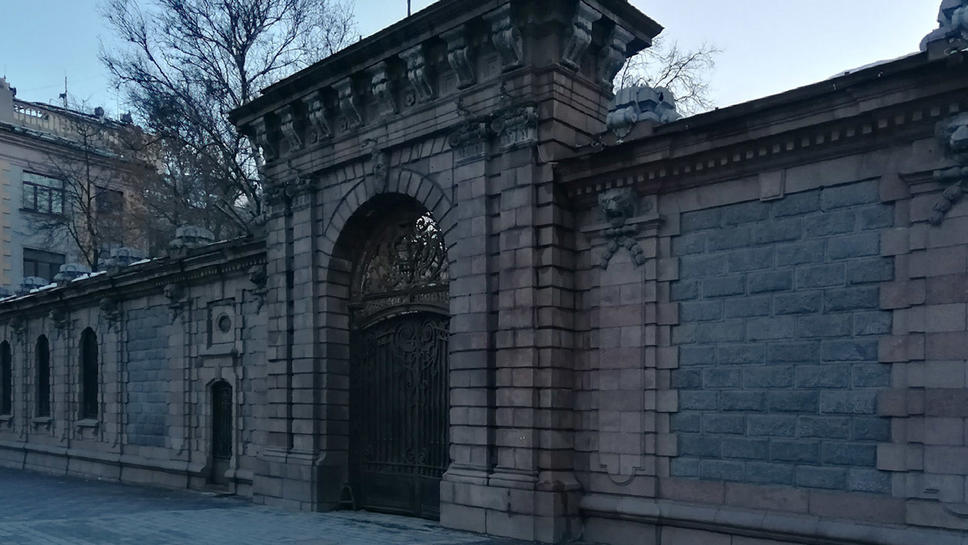 Stone fence
How its use changed:
Residential building
From 1986 to 1908, the mansion was at the disposal of its first owner. After von Derviz left for France, the house became the property of oil industrialist Lev Zubalov. The new owner lived there with his family until 1918.
Museum
In 1918, the Zubalovs decided to transfer the mansion and their art collection to the Rumyantsev Museum. From 1918 to 1921, the building functioned as a branch of this museum and as one of the storage facilities for exhibits belonging to the State Museum Fund. In 1924, the institution was disbanded and the Zubalov collection was distributed among key museums in the USSR. Most of the bronze items were transferred to Gostorg and sold through antique shops.
VNIIEM
From 1920, the estate was occupied by a special Technical Bureau of the Supreme Council of National Economy, after NII-20. In 1941, the organization was evacuated from Moscow. As a result of the transfer, the building was occupied by VNIIEM, headed from 1941 to 1993 by Iosifyan, a Soviet scientist who stood at the origins of cosmonautics and rocket science in our country. Today, the organization is called the Iosifyan Scientific and Production Corporation and is part of Roscosmos, which makes it impossible to take tours of this historical site.
Address of the estate and how to get there
The building is located at 4 Khoromnyy Dead End, Building 1. You can get there by metro to the station:
• Krasnye Vorota. From there, turn left, walk along Boyarsky Lane, turn right onto Khoromnyy Dead End Street, and continue along it until you reach the mansion. The walk takes about 2 minutes.
• Sretensky Boulevard. From this station, you can walk to the estate in 8 minutes. Walk along Myasnitskaya Street, turn onto Bolshaya Kozlovsky Lane, then onto Boyarsky Lane, turn onto Khoromny Dead End and walk along it to the building.
Tours of the von Derviz mansion are not organized because the building is located on the territory of a closed research institute. You can only enter the property with a pass.
In short: what beautiful houses are nearby?
Not far from the von Derviz estate are located:
• The main house of the Matveyev estate at 21/5 Volkhovsky Lane, building 1;
• The Lobanov-Rostovsky estate at 43 Myasnitskaya Street, building 1;
• The main house of the Evandyshnikova-E.M. Banza city estate at 3 Vorontsovo Pole Street, building 1.
Conclusion
The von Derviz estate is a cultural heritage site that combines unique architectural style and historical value.
Looking for an office building in Moscow? Click on the gold button below or call our experts at +7 (495) 032-28-29. We will select several suitable options for you and arrange a viewing the next day. All free of charge.