


Your request is accepted,
we will contact you soon
 Author of the article
Irina, expert of the project
Published: 27.11.2023
Views: 4 607
Views: 4 607
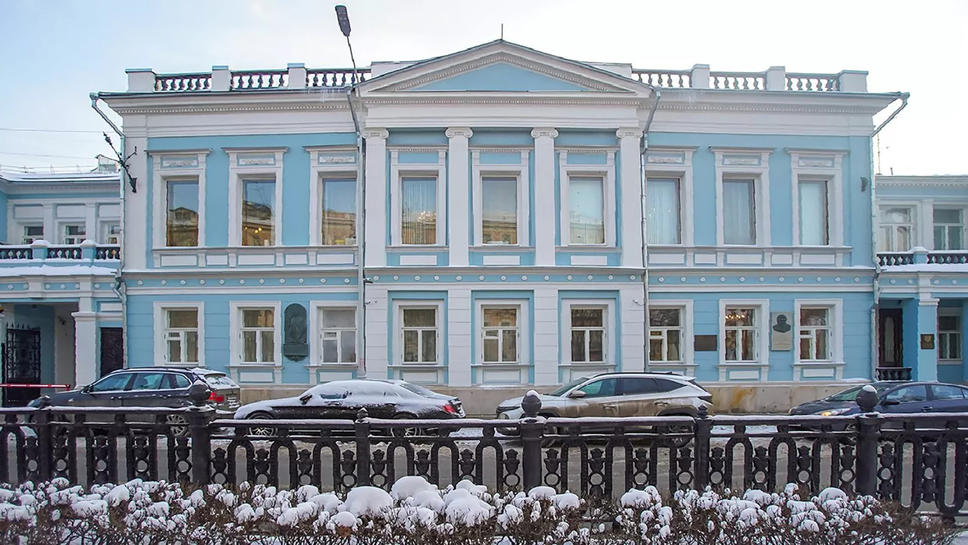
When you find yourself on Rozhdestvensky Boulevard in Moscow, you cannot help but notice and admire the luxurious sky-blue mansion proudly towering on the left bank of the Neglinnaya River, hidden in an underground collector. This legendary building has seen Tchaikovsky within its walls and witnessed meetings of the Decembrists. It is known to Muscovites and visitors to the capital as the house of the Fonvizin brothers.
What kind of house is this? General description
The mansion on Rozhdestvensky Boulevard is a federal cultural heritage site. The estate was built in the 18th century by order of Golitsyna. After the house was purchased in 1869 by Nadezhda Filaretovna von Meck, it was rebuilt several times. Two detached side wings were added to the main building, and the facade was decorated in an eclectic style. Skomorokh, Stratilatov, and Gamburtsev worked on the project.
History of design and construction
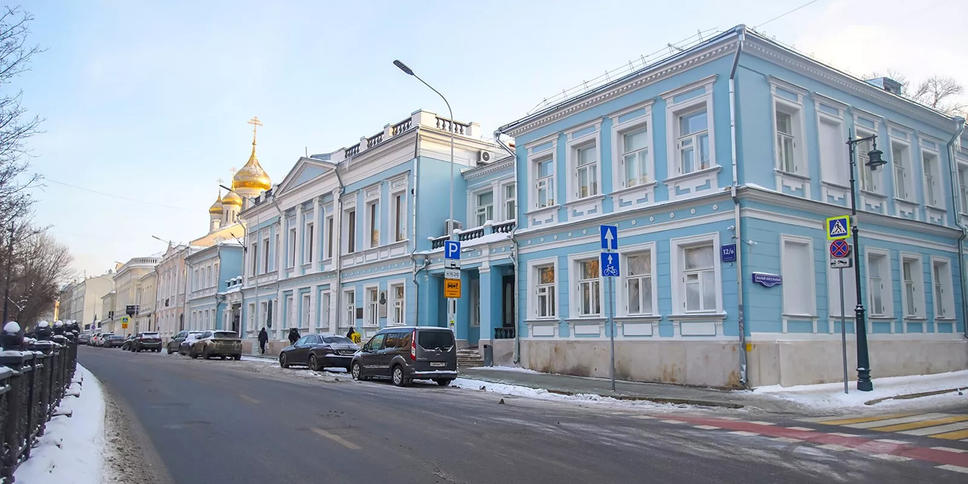
Although many people know the sky-blue mansion on Rozhdestvensky Boulevard as the Fonvizin family home, they were not responsible for its appearance in Moscow. Their father became the owner of this estate later. It was built at the end of the 18th century, and its first owner was Golitsyna. Initially, the mansion was a typical noble estate, consisting of a main building and two separate wings that stood along the boulevard. The main entrance was guarded by two formidable lions, but unfortunately, we cannot enjoy these sculptures today, as they have not been preserved.
Who was the first owner of the mansion?
The first owner of the estate, which was built between 1810 and 1816, as mentioned above, was Anastasia Mikhailovna Golitsyna, the wife of a retired second major of the Life Guard, who later received the rank of major general, Artemy Grigorievich Zagryazhsky. It was she who wished to build a luxurious city estate on the corner of Rozhdestvensky Boulevard and Maly Kiselny Lane.
 The main facade of the mansion
When and why the estate came to be known as the Fonvizin House
A few years later, the mansion was purchased by Colonel Alexander Ivanovich Fonvizin, father of the future Decembrists. Both sons of the mansion's owner were members of the “Union of Welfare” and often provided their home for meetings of this society. In 1825, Mikhail Fonvizin, who had been actively involved in organizing and leading the uprising, was sent into exile. In 1828, he was joined by his wife, Natalya Dmitrievna.
The history of the correspondence between Tchaikovsky and Baroness von Meck
In 1869, Nadezhda Filaretovna von Meck, known as Tchaikovsky's patroness, became the new owner of the estate. For many years, she provided financial support to the composer, whose music she admired, as she constantly informed him in her correspondence. Tchaikovsky never met his patroness, but her help allowed him to create freely, without having to obey the whims of his clients. When the composer fell seriously ill, Nadezhda Filaretovna asked Rubinstein to arrange for Pyotr Ilyich to move to her mansion, where he was well cared for.
Description of the interior and architecture
It was under Nadezhda Filaretovna that the house was decorated in an eclectic style. It was richly decorated with stucco moldings and coats of arms, and complemented with passageways with windows connecting the main building and separate wings. The main highlight of the house was the facade with a portico with four Ionic pilasters, a triangular pediment with a coat of arms, and a roof crowned with a balustrade. The passageways were also decorated with balustrades. The authors of the project placed it on the border between the first and second floors. According to Vladimir Gilyarovsky, two formidable lions previously guarded the entrance to the house, but these sculptures were lost during the Soviet era.
Overview of the building layout
According to Petr Petrovich Skomoroshchenko's design, all the buildings were connected by passageways. At the same time, another building appeared, located closer to Maly Kiselny Lane.
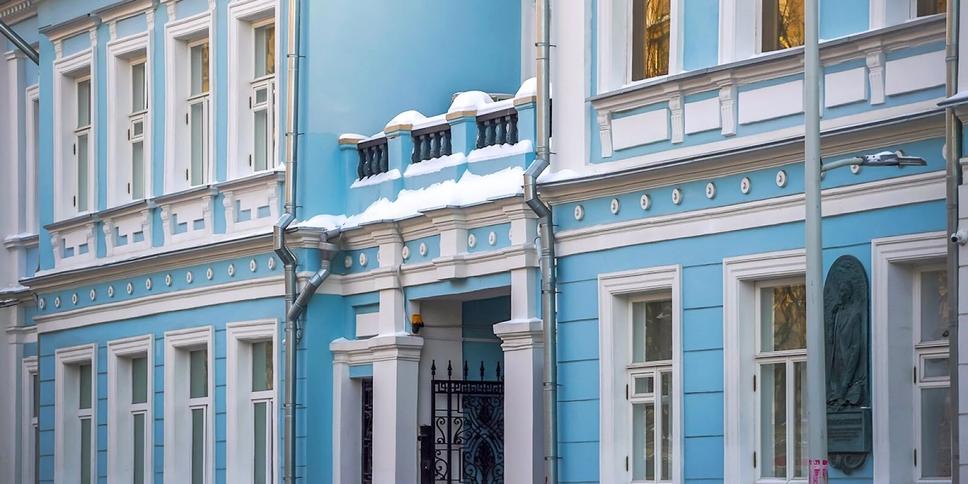 Facade decoration details
How its use changed:
During its existence, the mansion changed hands many times. Its purpose changed accordingly.
Residential building
The first owner of the building, Golitsyn, sold it to Colonel Fonvizin. In 1830, the house passed to Gubin, a merchant of the first guild, who partially rebuilt it. In 1869, he sold it to Nadezhda Filaretovna von Mek. In 1881, the house became the property of merchant and entrepreneur Alexei Semenovich Gubkin, who died in 1883. His death was indirectly responsible for the legendary stampede on Rozhdestvensky Boulevard, where thousands of beggars flocked for alms. Gubkin's heirs sold the mansion to the Noble Land Bank, which remained its owner until the 1917 revolution.
State Committee for Fisheries
Today, the building is occupied by the State Committee of the Russian Federation for Fisheries.
Possible renovation of the building
The building is scheduled to undergo restoration in the near future. Air conditioners will be removed from its facade. In addition, there are plans to repair the plaster layer, replace plastic windows with wooden ones, restore the base and oak doors, and return the walls to their original blue color.
Address of the estate and how to get there
The Fonvizin House is located at 12/8 Rozhdestvensky Boulevard, building 1. The easiest way to get to the famous mansion is from the Trubnaya metro station: it takes only 5 minutes on foot. It takes about 7 minutes to walk from Kuznetsky Bridge. Unfortunately, it is not possible to view the building from the inside, as it now houses the State Committee for Fisheries.
In short: what beautiful houses are nearby?
There are many luxurious mansions located next to the Fonvizin house on Rozhdestvensky Boulevard in Moscow. These include Princess Bebutova's apartment building, the Lagofit estate, Countess Rostopchina's mansion, and the Karamysheva city estate.
Conclusion
The estate is currently protected by the state as it is a cultural heritage site of federal significance.
If you would like to rent or purchase a building for a hotel in Moscow, click the button below or call +7 (499) 955-39-64.